Report draft
The Hidden Business Behind SaaS Launch Platforms
SaaS and Monthly Recurring Revenue
Software as a Service, or SaaS, is a cloud delivery model in which users access an application running on a provider's cloud infrastructure, typically through a browser or thin client, while the provider manages the underlying infrastructure, operating systems, storage, and application capabilities [1]. In practical terms, the customer does not buy and install a fixed software package; they subscribe to continued access to a hosted product.
This subscription structure is why SaaS businesses are often described through monthly recurring revenue, or MRR. MRR normalizes the predictable revenue generated by active subscriptions in a given month and separates recurring subscription income from one-time fees, services, or irregular purchases [2]. For founders, this makes SaaS especially legible: a small product can be judged not only by total sales, but by whether it is accumulating a repeatable revenue base month after month.
Microsoft Office illustrates the shift. In the packaged-software model, a professional Office license was installed locally and could cost roughly $400 as a one-time purchase. Adjusted for inflation, that is approximately $600 in 2026 dollars, depending on the exact release year used as the baseline. Microsoft 365 Business Standard, by contrast, is priced at $12.50 per user per month when paid annually, or about $150 per year for a single user [3]. The important change is not only the price level. It is the revenue logic: software moves from a discrete purchase to a recurring relationship.
The same pattern appears across consumer and professional software categories. Products that were once bought, installed, and kept on a local machine increasingly become continuously updated services tied to accounts, cloud storage, collaboration, and subscription billing. For customers, this can mean lower upfront cost and easier access. For vendors, it creates the recurring revenue base that makes SaaS financially attractive.
From AI-Assisted Coding to the SaaS Gold Rush
Generative AI has lowered the practical barriers to building software. AI-assisted coding tools can accelerate development work, while LLM-based zero-code platforms make it possible to create applications with little or no traditional programming [4, 5].
This change did not create the desire to build independent software businesses from scratch. That aspiration had been growing for years through the indie hacker movement, whose expansion is difficult to quantify precisely but became more visible around 2015, alongside the rise of IndieHackers.com as a community reference point for founders building profitable online businesses [6]. In that culture, developers could see monthly recurring revenue screenshots, growth charts, and stories of small software products replacing traditional salaries. The promise is simple and powerful: escape the 9-to-5, build an asset once, and earn recurring income over time. It also resonates with a broader post-pandemic disengagement from work, including the rise of “quiet quitting” [7].
Generative AI changes the feasibility of that dream. If more people can produce software, and if experienced developers can produce it faster, then the indie hacker promise becomes easier to act on. Claude Code 0.2.96, released in May 2025, marks one of the clearest milestones in this shift by making agentic coding available to Claude Max subscribers [8]. Around the same period, search interest for “saas” begins to rise sharply, suggesting a broader increase in attention around software and SaaS creation (see Figure 1).
SaaS becomes the obvious vehicle for this ambition. It is built with technologies developers already know, it can be launched by small teams or solo founders, and its recurring subscription model fits the fantasy of semi-passive income better than client work, agencies, or one-off apps. At the same time, research on generative AI in the IT sector links higher organizational adoption of AI with stronger employee job-security concerns [9]. These pressures make SaaS attractive for two reasons at once: it offers developers a familiar product format for experimenting with independence, and it turns the indie hacker promise of recurring revenue into a plausible response to uncertainty at work.
Worldwide search interest for “saas” since 2020
Figure 1: Worldwide Google Trends search interest for “saas” since 2020, with Claude Code 0.2.96 marked in May 2025. Values are normalized search interest.
The Remaining Bottleneck: Distribution
If building a SaaS product has become easier, the hard problem moves downstream. Distribution is the set of channels, tactics, and repeatable systems that get a product in front of the right potential customers and turn that attention into trials, signups, demos, purchases, and eventually recurring revenue. In other words, distribution is not simply "marketing" as a vague activity. It is the practical answer to a sharper question: where do customers come from?
This is where many new SaaS products stall. A founder can now ship a landing page, authentication, billing, and a polished interface faster than before, but that does not create demand by itself. The product still has to be discovered by people with the problem, trusted enough to try, and valuable enough to keep paying for. As the supply of small SaaS products increases, attention becomes the scarce resource.
The main distribution channels are not equally accessible to a first-time or solo founder. Paid acquisition requires capital, cold outreach requires targeting and sales execution, SEO requires patience and content know-how, and social distribution often depends on an existing audience or a strong publishing habit. Marketplaces and directories stand out because they let a founder place a product directly inside discovery environments that already have buyer intent.
- Paid ads: paying platforms to show the product to potential customers. Examples include Google search ads for people looking for a specific tool, Meta or LinkedIn ads aimed at a target audience, newsletter sponsorships, and sponsored posts.
- Cold outreach: contacting people directly even though they have not asked to hear from the product yet. Examples include cold emails to companies that match the ideal customer profile, LinkedIn messages to decision-makers, or direct messages to creators and small business owners.
- SEO:making pages that appear when people search for a problem, a product category, or an alternative to an existing tool. Examples include comparison pages, "best tools for..." articles, templates, guides, and landing pages for specific use cases.
- Content and social: publishing useful or interesting material so people discover the founder, the product, or the problem it solves. Examples include X and LinkedIn posts, YouTube demos, tutorials, build-in-public updates, case studies, and newsletters.
- Marketplaces and directories: listing the product where people already go to discover, compare, or review software. Examples include Product Hunt, app marketplaces, AI tool directories, SaaS directories, review sites, and startup launch platforms. This is often the most accessible option because it does not require a large ad budget, an existing audience, or advanced sales skills to get an initial product in front of potential users.
Startup launch platforms sit inside the marketplaces and directories category. They do not make a weak product strong, and they rarely replace an acquisition strategy on their own. Their appeal is more specific: they offer founders a visible place to announce a product, collect early users, earn backlinks, gather social proof, and test whether the market reacts. As building becomes more accessible, the business value of these platforms comes from helping founders fight the next constraint: not production, but discovery.
What Is a Startup Launch Platform?
A startup launch platform is a directory built around a time-bound product announcement. Instead of only listing software in a static catalog, it gives new products a launch window, usually a day, during which they compete for attention. Product Hunt is the clearest example: the homepage shows products launching today, each with a short description, categories, comments, and a vote count.
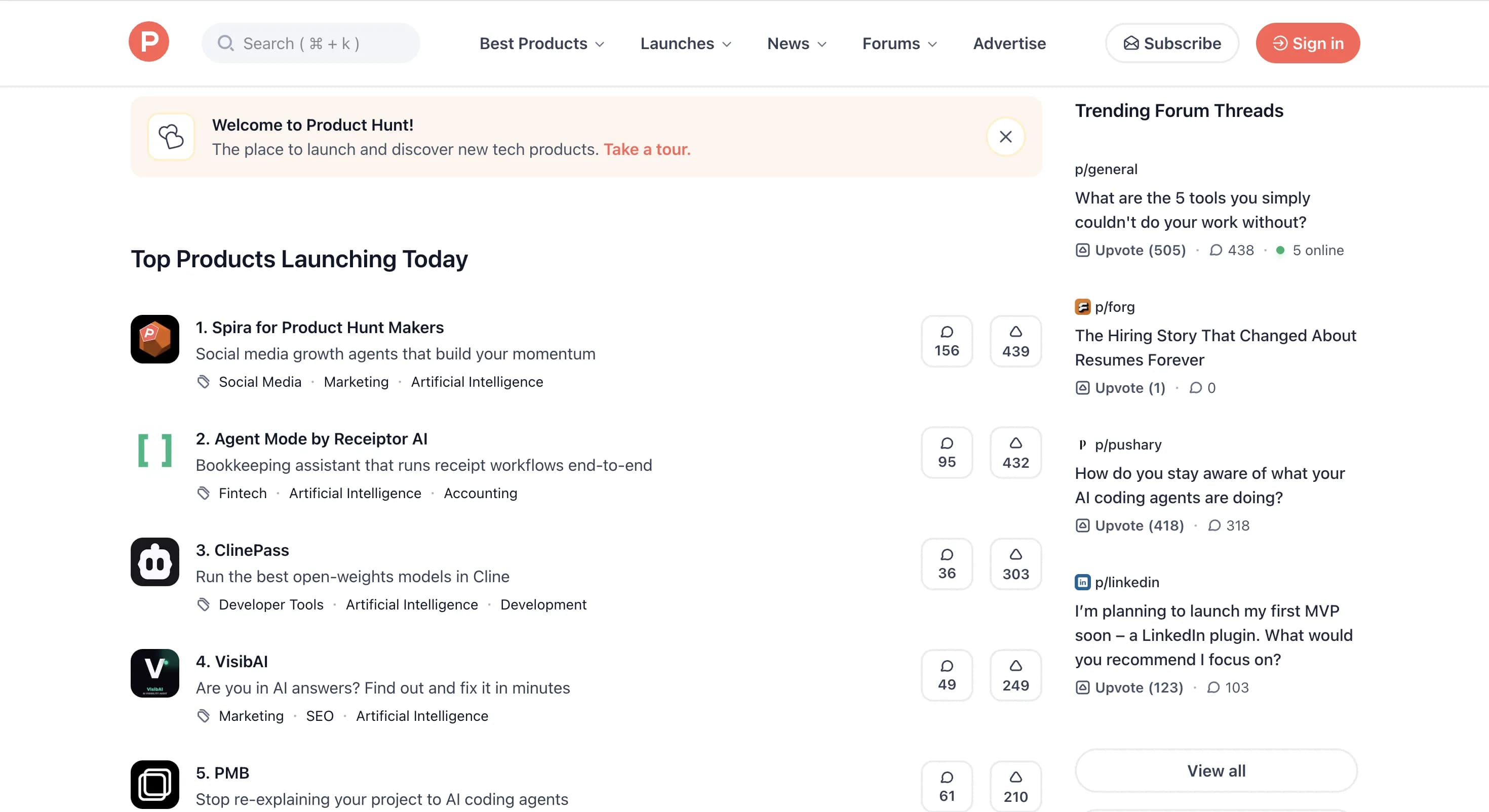
The voting mechanism is central. Users can upvote a launch, comment on it, and share it with their own network. More votes and comments can push a product higher in the daily ranking, which creates a feedback loop: visibility brings traffic, traffic can bring more votes, and more votes can create still more visibility. For founders, the goal is not only to appear on the platform, but to concentrate enough early attention into a short window to move up the leaderboard.
This makes launch platforms different from ordinary directories. A normal directory helps people find software over time; a launch platform adds urgency, social proof, and a public ranking game. It turns distribution into an event. A successful launch can send visitors to a landing page, generate signups, attract comments from early adopters, create a backlink, and give the founder a visible proof point to reuse elsewhere.
Worldwide search interest for “product hunt” since 2020
Figure 3: Worldwide Google Trends search interest for “product hunt” since 2020, with Claude Code 0.2.96 marked in May 2025. The series rises from a 2024 average of 9.2 to 28.3 in 2025 and 67.0 across January-June 2026, with a normalized peak of 100 in February 2026.
As more developers start creating SaaS products, they also need a first place to show those products to potential users. Launch platforms naturally become one of the earliest distribution channels founders try: they are easy to access, often free or low-cost, and can generate traffic almost immediately after submission. The recent rise in Product Hunt search interest (see Figure 3) suggests that this reference launch platform became more visible at the same time as more founders were looking for accessible ways to distribute new software. They do not solve distribution by themselves, but they offer a practical first step for founders who do not yet have an ad budget, a sales process, steady traffic from Google, or an existing audience.
This raises a second question: if launching is free, how do launch platforms make money? The free launch can work well for the winners of the daily ranking because they receive attention, clicks, comments, and early users. But the deeper value offered by many launch platforms is the backlink. A backlink is simply a link from one website to another. For a SaaS founder, a link from a public launch page to the product website can matter because Google uses links as one signal to discover pages and understand whether other sites consider them worth referencing. In practical SEO terms, backlinks can help a new product look less isolated on the web and can support its ability to rank for relevant searches over time.
The Market for Attention and Backlinks
Launch platforms sit at the intersection of two markets. The first is the market for attention. A new SaaS product needs people to notice it, click it, discuss it, and try it. The platform concentrates that attention into a daily feed, a ranking, a newsletter, a homepage placement, or a category page. This is why paid upgrades can make sense even when the basic launch is free: founders are not only paying to be listed, they are paying for more visibility inside a place where potential users are already browsing new products.
The second is the market for backlinks. A launch page is not only a source of same-day traffic; it can become a permanent page on the web that links back to the product. For small SaaS companies, this matters because they often start with no reputation in search engines. A backlink from a relevant directory, marketplace, or launch platform can help Google discover the site, associate it with a product category, and treat it as part of a broader web of references rather than an isolated page.
This explains the business logic behind many launch and directory platforms. Free submissions bring supply: founders add products, enrich the database, and give visitors something new to browse. Monetization then happens around scarce placement and SEO value: featured listings, promoted launches, newsletter sponsorships, faster reviews, premium profiles, category boosts, or packages that promise additional exposure. The product being sold is not software in the traditional sense. It is access to discovery.
References
- Mell, P., & Grance, T. (2011). The NIST definition of cloud computing (Special Publication 800-145). National Institute of Standards and Technology. https://doi.org/10.6028/NIST.SP.800-145
- Paddle. (n.d.). What is MRR? Calculate & increase your monthly recurring revenue. https://www.paddle.com/resources/monthly-recurring-revenue
- Microsoft. (n.d.). Microsoft 365 business plans and pricing. https://www.microsoft.com/en-us/microsoft-365/business/microsoft-365-plans-and-pricing
- McKinsey & Company. (2023, June 27). Unleashing developer productivity with generative AI. https://www.mckinsey.com/capabilities/tech-and-ai/our-insights/unleashing-developer-productivity-with-generative-ai
- Pattnayak, P. (2025). Review of tools for zero-code LLM based application development. arXiv. https://arxiv.org/abs/2510.19747
- Indie Hackers. (n.d.). About Indie Hackers. https://www.indiehackers.com/about
- Gallup. (2022, September 6; updated 2023, May 17). Is quiet quitting real? https://www.gallup.com/workplace/398306/quiet-quitting-real.aspx
- Anthropic. (2025, May 1). Claude Code changelog: 0.2.96. https://code.claude.com/docs/en/changelog#0-2-96
- Bonin, A. L., Smolinski, P. R., & Winiarski, J. (2025). Exploring the impact of generative artificial intelligence on software development in the IT sector: Preliminary findings on productivity, efficiency and job security. arXiv. https://arxiv.org/abs/2508.16811